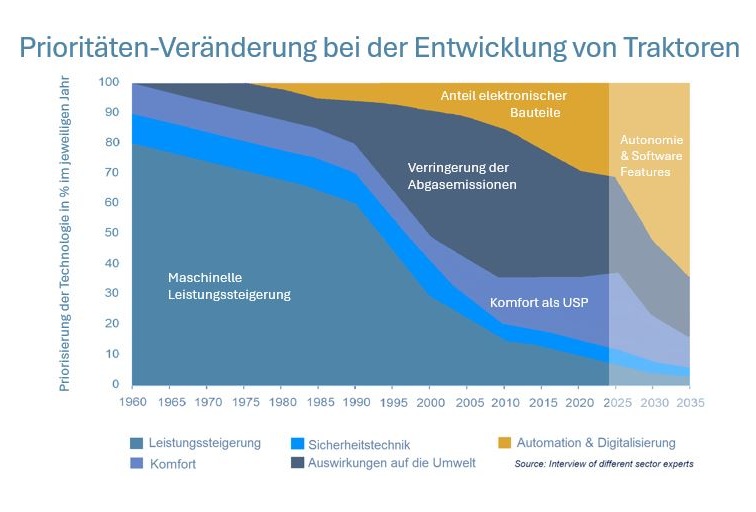
I really like this graphic—so simple, so clear, so unambiguous.
It illustrates very clearly how priorities in tractor development have shifted.
Away from purely mechanical performance parameters and toward electronics, software, connectivity, telematics, and sustainability.
Digitalization and automation are now the dominant areas!
This shift is not an isolated phenomenon in the agricultural machinery industry but exemplifies a cross-industry paradigm shift.
The focus is clear: electric, connected, autonomous… and AI is playing a major role.
The tractor that drives itself to precisely navigate the fields, plowing, sowing, or mowing. The excavator that autonomously digs the specified foundation pit. As early as 2019, Doosan/Develon had already controlled a 40-metric-ton excavator via 5G from the Bauma trade show in Munich to South Korea, coining the term “TeleOperation” in the process. Autonomous vehicles that move, sort, and assign containers in port facilities… all of this is already a reality.
So it’s no longer about incremental improvements to what already exists, but about reinvention
This development has accelerated in recent years—and this is the case across all industries. These innovations require different business models in order to function.
The way value is created has thus changed enormously and continues to change (due to technology). When the market and market conditions change so drastically, the company—with all its working methods, offerings, organizational structure, culture, processes, technologies, and personnel—must also change and adapt to the new conditions.
For the business model, this means defining a new value proposition.
We find ourselves in this colorful transitional phase of radical change. We must not only be able to endure it but also want to shape it. I believe it’s important to adopt a fundamentally positive attitude toward this in order to see all the opportunities.
To better understand the significance of this situation, it’s a good idea to explore the cycle of “creative destruction,” which Schumpeter originally developed and which has since been further refined by Joel Mokyr, Philippe Aghion, and Peter Howitt (link in the comments). At its core, it’s about the existing giving way so that something new can emerge.
Georgiy Michailov and Jan Stange describe very clearly in their book *Business Model Redesign* how the new can emerge.
Those who don’t keep up with the times will be left behind. Nothing stays the same… and we’re already seeing the first effects of delayed responses in the market.
Nothing is as misguided as trying to shape the future using the formulas of the past.
How are you dealing with this change? What are your experiences? Feel free to share your thoughts in the comments.